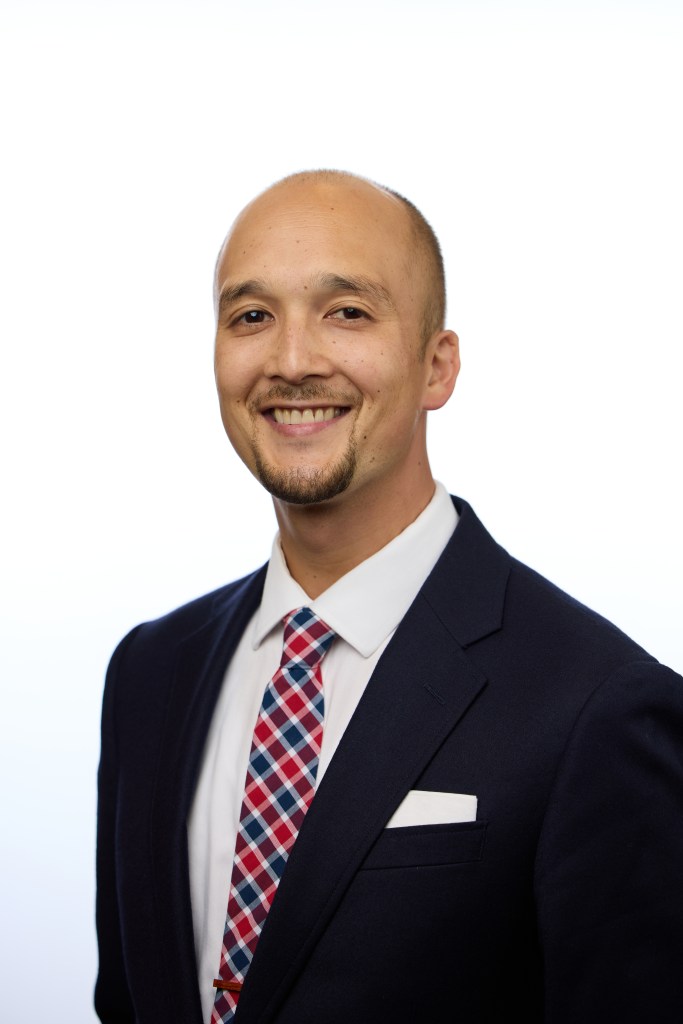
Dr. James “Jimmy” McCarty (he/him/his) was born in Daegu, South Korea, and raised in Tacoma, WA. He is the son of a white American father from Tennessee, and a Korean, immigrant mother. He is a multiracial Asian American who grew up in the American Christian tradition called the Churches of Christ.
Dr. McCarty earned his high school diploma from Spanaway Lake High School, his B.A. in Religion from Pepperdine University, an M.A. in Ethics from Claremont School of Theology, and his Ph.D. in Religion (Ethics and Society) from Emory University. He has delivered academic papers and lectures nationally and internationally, and has published in journals of religion, theology, ethics, and law.
He now resides, with his spouse Desiree, in Boston, MA, where they enjoy walking in urban green spaces, cooking vegetarian food, and exploring New England.
The Scholar
Dr. McCarty is presently the Clinical Assistant Professor of Religion and Conflict Transformation and Director of The Tom Porter Religion and Conflict Transformation Program at Boston University School of Theology. There he regularly teaches courses in the ethics and practice of conflict transformation, restorative justice, and community organizing. He also administers the graduate certificate in Religion and Conflict Transformation in partnership with the Boston Theological Interreligious Consortium.
Dr. McCarty is a co-editor of the book The Business of War: Theological and Ethical Reflections on the Military-Industrial Complex. This book inspired a series with Cascade Books titled “The Business of Modern Life,” to examine the role of neoliberal global capitalism in modern social, economic, and political life, and for which several volumes are in process. One of these is his 2025 co-edited book The Business of Incarceration: Theological and Ethical Reflections on the Prison-Industrial Complex.
He is also currently writing his first solo-authored book tentatively titled We Are Only Human Together: A Theological Account of Justice as Healing. The book will provide a theological interpretation of social justice movements that describe justice as a form of healing. McCarty has also published scholarly essays on racial justice, truth and reconciliation commissions, Asian American Christian Ethics, restorative justice, Desmond Tutu, Martin Luther King Jr., and the ethics of hope in academic journals such as the Journal of the Society of Christian Ethics, Theology and Sexuality, Journal of Religious Ethics, and the Journal of Law and Religion.
The Practitioner
In additon to his scholarship, Dr. McCarty is an experienced and skilled practitioner in restorative justice, especially peacemaking circles. He is also an experienced community organizer, with a special focus on antiviolence and peace organizing in urban settings. Beyond the United States, Dr. McCarty has worked and conducted research in the areas of international human rights and peacebuilding in East and Southern Africa.
In addition to his activist work, McCarty has over a decade of ministry experience. He has led justice ministries in predominantly white and Black churches in greater Seattle and Los Angeles, and spent several years as a university chaplain.
Dr. McCarty also has experience leading diversity, equity, inclusion, and antiracism initiatives and offices in private and public universities. He has formal training in peacemaking circles, mediation, Kingian nonviolence, broad-based community organizing, bystander intervention, restorative justice in schools, and inclusive, antiracist, and decolonial pedagogies.*
*As my teachers have taught me, an important practice of peacebuilding is honoring one’s teachers. In that spirit I name some of them here. I first learned about nonviolent direct action by studying the teachings of Jesus of Nazareth, Mohandas “Mahatma” Gandhi, and Rev. Dr. Martin Luther King Jr. I then deepened my learning and practice by learning from and participating in organizing efforts led by Rev. James Lawson in Pasadena and Dr. Bernard Lafayette in Atlanta. I was first taught to practice and keep peacemaking circles from Saroeum Phoung (Khmer) and Shasta Cano-Martin (Lummi), who trace their circle keeping lineage through Harold Gatensby (Tlingit), Phil Gatensby (Tlingit), Mark Wedge (Tagish/Tlingit), and Barry Stuart. In addition, I owe much to professors who taught and mentored me over the years. In particular, I would not be the scholar I am today without my advisors and readers for my master’s thesis and doctoral dissertation: Ellen Ott Marshall, Monica A. Coleman, Elizabeth M. Bounds, and Pamela Scully. Finally, I want to honor those who mentored me in Christian ministry: Dennis Baker, Vincent Hawkins, Ezra Plank, Jen Rogers, Francis Mbuvi, Jackton Omondi, and Don McLaughlin.
 Dr. James W. McCarty